
Service & Support
Reliable processes require reliable partners. Our service and support team helps you operate your feeding systems and control solutions optimally at all times. Whether technical questions, commissioning, spare parts, or individual requirements—we are at your side with experience, expertise, and short response times.
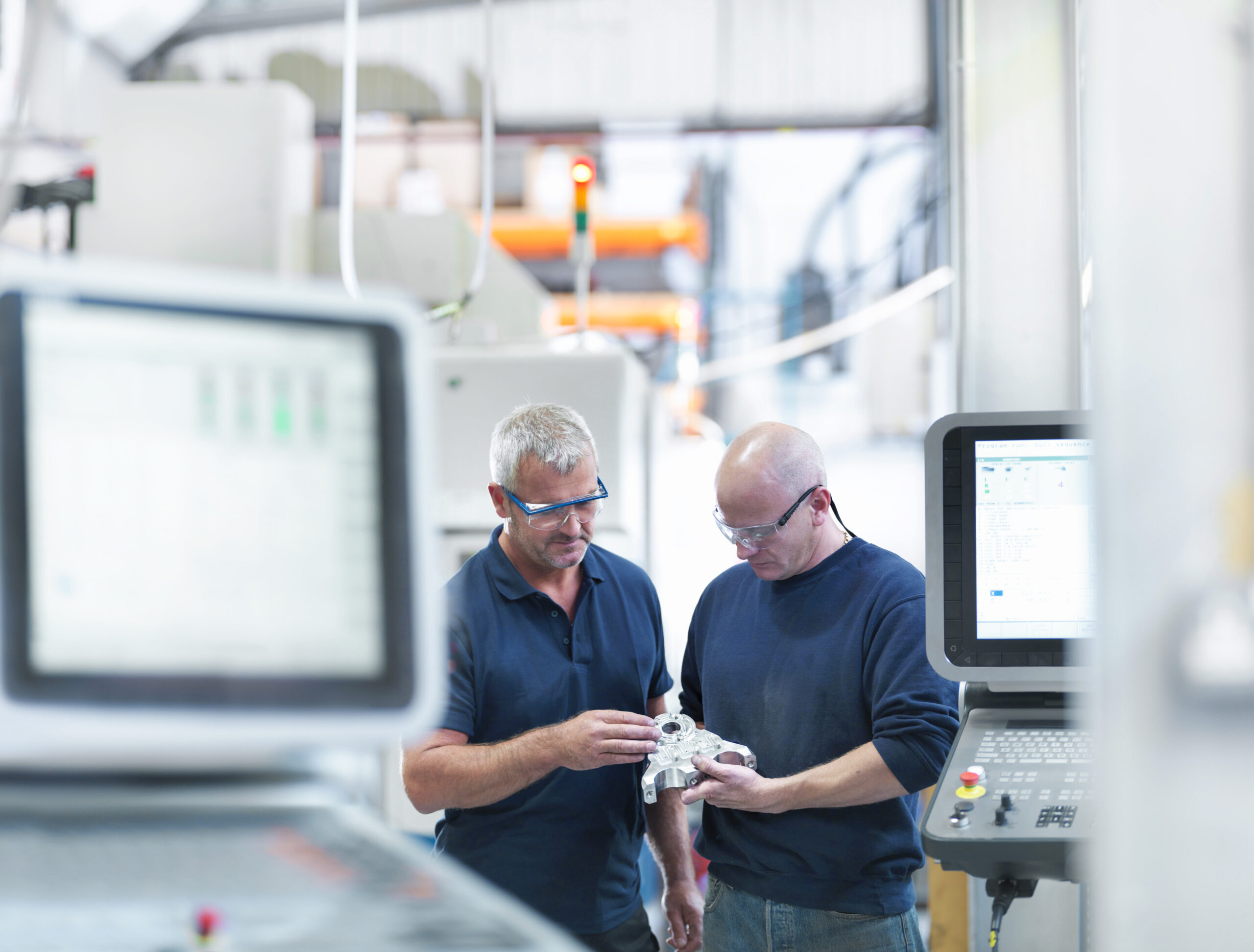
technical support
Our technical support helps you quickly and precisely with all questions regarding the installation, configuration, and operation of our vibration and control systems.
We accompany you from the initial inquiry to successful implementation—including fault analysis, optimization recommendations, and support for specific applications.
Thanks to comprehensive know-how, you receive solution-oriented support that is precisely tailored to your system and your production processes.
FAQ
Here you will find answers to typical questions about our control units, applications, and services.
A control unit for vibratory feeders is an electronic device that regulates the movement and feed rate of vibratory feeders. It controls how strongly, how quickly, and in what rhythm a feeder vibrates in order to transport components or bulk material in a controlled, uniform, and reproducible manner.
Our control units are used wherever parts need to be singulated, sorted, dosed, or fed—typically in automated production and assembly processes.
Depending on the design, the control unit regulates:
- the vibration amplitude (feed rate),
- the vibration frequency,
- the switch-on and switch-off behavior (e.g., soft start or delays),
- as well as additional functions such as cyclic operation, jam or level monitoring, or interfaces to the machine control system (PLC).
A correctly designed control unit is crucial for:
- stable processes,
- uniform part feeding,
- low wear on feeders,
- energy-efficient feeding
- and high production reliability.
Our control units are used wherever components are fed, singulated, or sorted. Typical industries include automotive, medical technology, electronics manufacturing, packaging, and general mechanical engineering. They are used in both series machines and special-purpose systems.
The choice of the right control unit depends on the feeding task, frequency requirements, load, sensors and actuators, and desired control accuracy. Our support team will be happy to help you with the selection.
With open-loop control, the control unit operates without feedback from the feeding process. It provides fixed settings but does not respond to load or process changes.
A closed-loop control measures the actual movement of the feeder (e.g., via sensors) and automatically adjusts to ensure a constant feed rate.
Phase-angle control is used when simple vibratory feeders are operated with constant load. It is robust, cost-effective, and sufficient for many standard applications.
Frequency control is used when the feeding process needs to be precise, stable, or adaptable. Frequency control is also energy-saving and can significantly reduce commissioning times, as complex adjustments to the feeders are eliminated. The variable frequency allows the feeder to be optimally tuned to its mechanical properties—especially with changing loads or high quality requirements.
In a closed-loop control system, we recommend operating the feeders at resonance frequency. In an open-loop control system, the ideal frequency is usually below the resonance frequency of the vibrator. This allows the drives to run stably but dissipates more energy. The setting of the vibration frequency depends on the selected model.
The control unit determines how uniformly and stably a feeder operates. It regulates the vibration amplitude and—depending on the design—also the frequency, and adapts the performance to changing conditions.
A well-tuned control unit ensures:
- constant feed rate,
- stable processes,
- fewer blockages and rejects.
Unsuitable or incorrectly adjusted control units, on the other hand, often lead to fluctuating feeding and unstable processes.
A good control unit meets the following two main requirements:
- During the commissioning of a feeding line, it serves as the main control unit and enables rapid and simple commissioning.
- After the feeding line is integrated into an overall system, the control unit assumes a subordinate function and takes over the precise control of the feeding technology. They are usually connected to the higher-level machine control system (PLC).
Proper integration ensures that:
- part feeding occurs synchronously with the machine process,
- feeders reliably start, stop, or pause,
- faults are detected early.
Control units are connected to higher-level PLC control systems either via digital or analog inputs and outputs or via industrial bus interfaces. This allows the higher-level control system to specify start, stop, enable, or operating modes while simultaneously querying states or faults.
The PLC handles the logical process control, while the control unit for feeding systems takes over the precise regulation of the feeding movement.
While the share of fieldbuses decreases annually, the market shares of Ethernet-based industrial buses continue to rise. Among Ethernet-based industrial buses, the following three standards are by far the most widely used:
- Profinet
- Ethernet/IP
- EtherCAT
Modern control units monitor operating states such as current, temperature, or sensor signals and report deviations early. Status displays or error messages help detect faults quickly and prevent downtime. Since our control units are largely maintenance-free, the effort is usually limited to visual inspections and functional checks.
An optimally tuned control unit ensures that the feeder operates only with the required power. This reduces energy consumption and places less stress on mechanical components. This reduces wear on springs, coils, and bearings and extends the service life of the overall system.
The right control unit protects feeders from overload, incorrect frequency, and thermal stress. This significantly extends service life.
A retrofit—i.e., replacing older control units with new ones—is worthwhile when modern functions such as better control, diagnostics, or energy efficiency are to be retrofitted without replacing the mechanics.
We are happy to advise you individually on whether such a replacement could be worthwhile for you.
Yes. We support with parameterization, frequency determination, sensor integration, PLC connection, and troubleshooting—remotely or on-site.
Yes. We offer customized control parameters, OEM solutions, and system consulting for complex feeding systems.
MOBADRIVE is the further development of the former Schmocker business division for control units for industrial feeding technology. The know-how, technical expertise, and product understanding from Schmocker’s history are fully integrated into Mobadrive. For customers, this means: continuity in technology and understanding, combined with a clearer, future-oriented focus.
The new name MOBADRIVE makes it clearer what the business division stands for: drive, control, and motion in industrial applications. At the same time, it enables a clearer and internationally understandable positioning.
Furthermore, the name MOBADRIVE fits seamlessly into the brand and corporate structure of the Moser-Baer Group and consistently complements existing business divisions such as MOBATIME within the same naming and brand concept. The technical DNA, know-how, and many years of experience from Schmocker are fully retained.
Glossary
In our glossary, you will find understandable explanations of key terms from feeding technology, vibratory feeding, and industrial automation. The overview helps you quickly classify technical terminology and better understand the functionality of our control units and their application.